
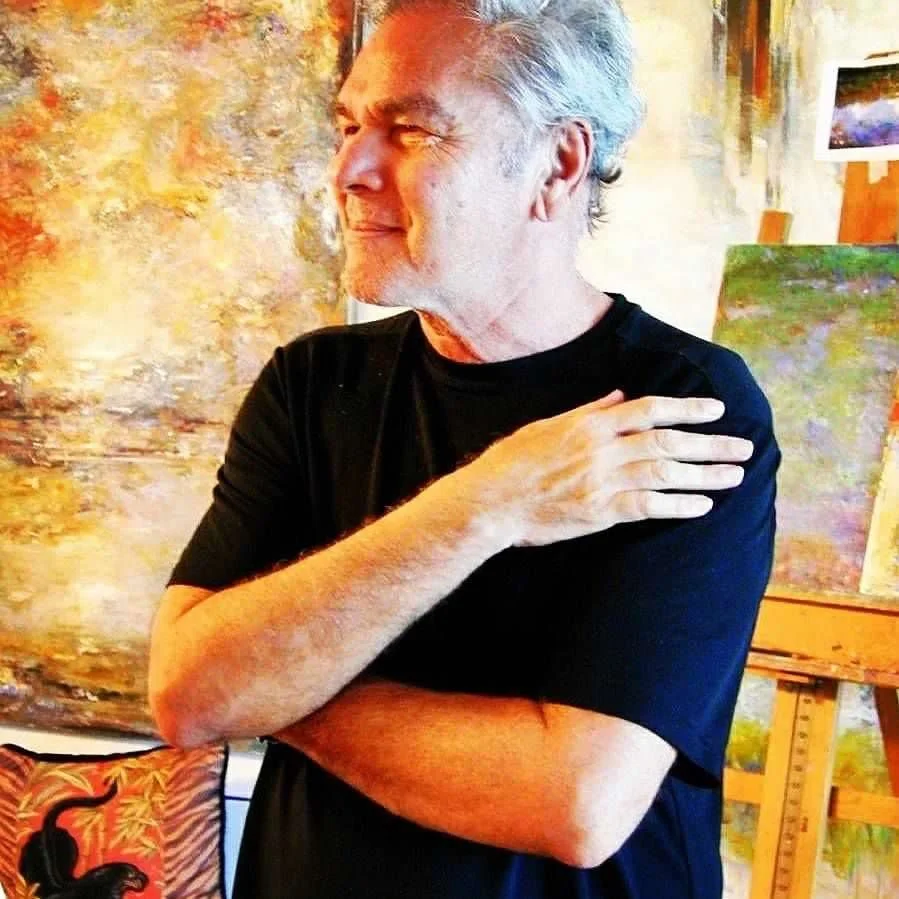
Francesco Agresti
The following biographical overview includes selected exhibitions, teaching appointments, stylistic development, and key affiliations across the artist’s life and career.
The following artist biography includes selected exhibitions, teaching appointments, stylistic development, and key affiliations across the artist’s life and career.
1949
Born in Itri, Italy
1956
Immigrates to the United States with his parents and his brother Joe. Lives in the Bronx, New York where his mother works as seamstress and his father as a construction carpenter.
1972-1977
Agresti earns his BFA and then his MFA from Hunter/Lehman College, with his MFA tuition sponsored by his brother Joe. Despite his work being much more somber in color palette and restrained in its geometry, a professor recognizes his work for conveying its own light, ‘’Rembrandt’s light.’’ He is formally associated with the Post-ABEX movement, as his work conveys the minimalism
and the ‘’geometry of the day,’’ as Agresti describes it.
Early 1980s
As a young artist, Agresti comes out into the New York art scene in a group show, “14 Painters,” with several other abstract artists who have gained distinction and notoriety since, including David Reed, Len Bellinger, Sean Scully, and others, at Lehman College Gallery, Bronx, NY. Agresti is also included in the Artists in the Marketplace (AIM) exhibition at the Bronx Museum.
1980s
While Agresti does attract the attention of a few notable New York collectors and patrons, including Catherine Markel of Markel Gallery, his work is shown inconsistently and he describes this time as a period of stress. Looking for a practical way to support himself, he takes a job at a post office where his spirit dwindles.
1988–1993
Feeling like a failure, Agresti returns to reside in Itri, Italy, on the family's olive orchard where he also encountered his brother Joe recovering from PTSD from his time in service in the Vietnam War. However, what ensues is not a collapse, but a rebirth, as the natural landscape of Italy and the slower lifestyle heals him. He continues to paint, and his abstractions take a narrative turn, involving more poetry and more glimpses of the representational world around him, such as, funeral processions, frescoes, and horses. He teaches art appreciation at the University of Naples and in 1992, he has a solo exhibition at Galleria Punto Arte, Fondi, Italy
1993-2002
Returns to the United States, finding work as a lecturer in several historically black colleges, in North Carolina, including North Carolina A&T State University, Winston‑Salem State University, Forsyth Community College, and finally securing a full time professor role at Guilford Technical Community College, where he meets his beloved Helga.
2001
Agresti shows his Noli me tangere (translation from Latin, touch me not), series in the exhibition “A Question of Faith,” at A&T State University in North Carolina, organized by notable curator Eleanor Heartney.
2003 - 2020
With his partner and great supporter, Helga, Agresti relocates to Venice, Florida and returns to art making full time. Meditations on Florida’s coastal light, ocean, and sea oats evolve into the signature style of Agresti late period, with horizon bands and cross-hatching. Agresti shows with a few different regional gallery partners, including Gallery du Soleil, in Naples, Florida. In 2020 Helga passes.
2020–2026
Agresti forms a new relationship with partner Teri, that continues to fuel his creative passions and pursuits. Living between Scituate, Massachusetts, and Venice, Florida. Agresti teaches at Venice Art Center and enters a prolific period of art making, hybridizing styles from across his career. He becomes bolder with his marks, even creating slits in the canvas, freeing himself from containment, from his thoughts, and from his past.
2026
Agresti re-emerges with a solo exhibition at Browne Art Gallery in Saint Petersburg, Florida, focusing on key artistic evolutions from the latest period of stylistic hybridization. ▪️